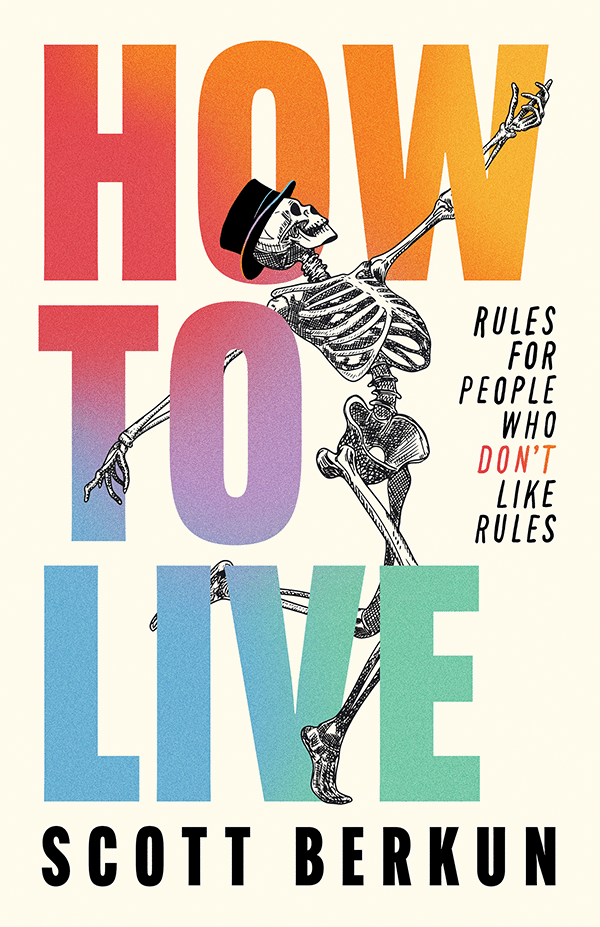
A personal, sincere, and approachable take on the everyday philosophies we take for granted.
Most self-help books lean heavily on manufactured drama. They thrive on dramatic epiphanies: “You think you know how this works? Think again! Let me reveal a shocking secret!” It’s a classic hook designed to grab attention, but it rarely reflects how life actually works, with all the bittersweet nuances we can’t avoid.
In How to Live: Rules for People Who Don’t Like Rules, Scott Berkun takes the opposite route. He doesn’t offer theatrical revelations or pre-packaged life hacks. Instead, he grounds the book in three rare qualities: it is deeply personal, disarmingly sincere, and genuinely approachable.
Rather than claiming we lack answers, Berkun suggests something simpler: modern life moves too quickly for us to think through the basics. We don’t need more rigid formulas. Instead, we need space to think philosophically about ordinary things.
No epiphanies, no silver bullets—just a refreshingly sincere, personal, and approachable invitation to think for yourself.
Approachable: Commonplace Rules That Demand Deeper Thinking
When I used to advise nonfiction authors as an editor, my first rule was always: your table of contents must tell an engaging story.
At first glance, Berkun’s table of contents seems almost underwhelming: “Don’t die,” “Be self-aware,” “Think slow,” “Be here now.” Why pick up a book whose chapter titles sound so plain?
Because that simplicity is precisely where its approachability lies. We skim past these intuitive truths every day because utilitarian demands leave little time to chew on heavy philosophy classics. Berkun bridges that gap. He doesn’t lecture from an ivory tower; he invites you in, using clear language to translate classical philosophical weight into quick, engaging reads. It’s an approachable doorway to your own thinking—not a promise to think for you, but a practical prompt to let you examine what you take for granted.
Personal: Experience Used as a Mirror, Not a Universal Law
Another common pitfall in self-help is turning a single personal triumph into universal dogma: “It worked for me on a Tuesday, so here is your four-step blueprint for life.”
Berkun shares plenty of personal stories here, many of them quiet, candid, and moving. But crucially, he never treats his personal history as an absolute template for yours. Instead of prescribing plug-and-play solutions, he uses his stories as mirrors. The hard work of contextualizing any rule—deciding when it applies, when it bends, and when it fails—can only ever be done by you. Bad books claim they can skip that work for you; a good book equips you with the curiosity and critical distance to do that work yourself.
Sincere: Inviting Nuance Through Gentle Reframing
Sincerity in writing shows up when an author trusts the reader’s intelligence. Berkun frequently pauses to offer mental exercises and gentle invitations: “Here is another way to observe yourself.”
Rather than settling for neat binaries, the book actively hunts for nuance at the intersection of different perspectives. You get the distinct pleasure of reframing ideas you thought were settled, landing on that satisfying spark of, “I’ve never looked at it from that angle before.” His rules are less about obedience and more about exploration. It lives up to its subtitle, Rules for People Who Don’t Like Rules, by quietly delivering two bonus layers: rules for thinking about rules, and a way of thinking for people who resist being told what to do.
At roughly 100 pages, How to Live accomplishes something too few books manage: it reads like a breezy 30-minute conversation, yet leaves behind the intellectual residue of a 300-page study. It strips away the grandiosity of traditional philosophy while dodging the shallow certainty of modern self-help.
Conclusion
Personal in its anecdotes, sincere in its refusal to oversimplify, and approachable in every line, it’s a sharp, delightful guide to reflecting on the only life you can actually design—your own.
Highly recommended!

Disclaimer: AI was used in editing the text content of this page. Visit RAID for more information.

