
One cannot really build, evolve, or change culture without getting into the messy details of particular cultures.
The Corporate Culture Survival Guide by Edgar H. Schein
Culture consists of underlying assumptions (existential statements about how things work), values (shared understandings of what is good and bad), norms (shared understandings of what is normal and abnormal, of what we do and how we do it), and symbols (tangible artifacts like clothing and office décor, intangible elements like stories and ceremonies)…
The Power of Organizations by Heather A. Haveman
Here comes the organizational culture cube:
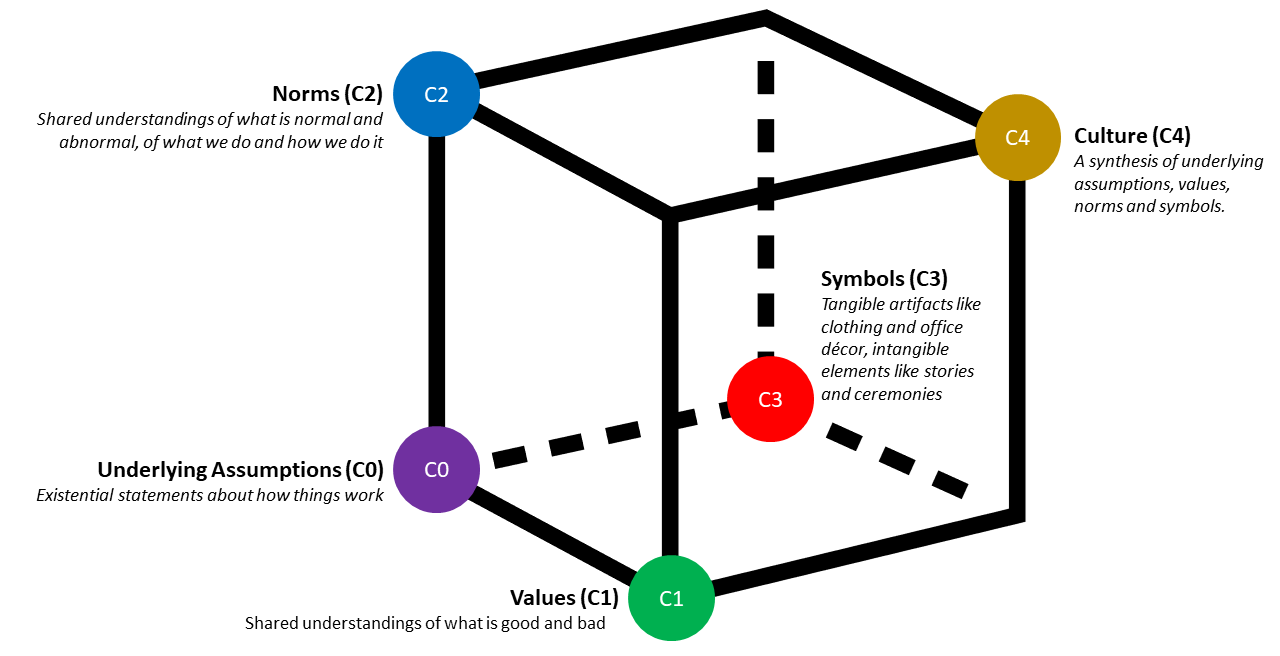
The Organizational Culture Cube establishes a 3-dimensional model of culture, which consists of four components:
- Underlying assumptions: existential statements about how things work
- Values: shared understandings of what is good and bad
- Norms: shared understandings of what is normal and abnormal, of what we do and how we do it
- Symbols: tangible artifacts like clothing and office décor, intangible elements like stories and ceremonies
The 3-dimensional view provides an interesting leeway to talk about how organizational culture evolves – it almost always starts from some underlying assumptions, but then the paths to a full-fledged culture vary (how it evolves from C0 to C4 in a 3-dimensional cube space).
Culture cannot be learned by organizational newcomers by poring over rule books or manuals; instead, it must be learned through direct experience. Old-timers regale newcomers with stories that reflect organizational values and norms. Language, especially organization- or occupation-specific jargon and slang, has shadings of value baked into it […] Job titles and other labels demarcate what is valued and despised. Ceremonies, rituals, and rites of passage vividly enact central cultural elements. How organizational members act every day—their interaction styles, etiquette, and dress—reveals behavioral expectations. Finally, physical structures and their layout teach silent lessons about what is (not) important.
The Power of Organizations by Heather A. Haveman
A leader’s personal culture influences how the org culture evolves. For example, some cultures evolve norms and symbols faster/earlier than values (from C0 to C2/C3), while others evolve values and symbols better than norms (from C0 to C1/C3), and so on.
…culture and leadership are two sides of the same coin and one cannot understand one without the other.
The Corporate Culture Survival Guide by Edgar H. Schein
And that entanglement complicates how we approach leadership:
One reason why it is so hard to define leadership is that there are so many “correct” versions, each reflecting one of the many kinds of successful organizations that exist in the world, each with its own culture.
The Corporate Culture Survival Guide by Edgar H. Schein
There are cultures and there are subcultures:
…leadership cannot really be understood without consideration of cultural origins, evolution, and change. In the same way, organizational culture and subcultures cannot really be understood without considering how leaders at every level and in every function of an organization behave and influence how the total system functions. Organizational functioning is heavily dependent on how existing subcultures align with each other, which means that it is critical for leaders to understand and manage subculture dynamics.
The Corporate Culture Survival Guide by Edgar H. Schein
And the matter of control is unintuitive when it comes to organizational culture:
…culture controls you more than you control culture. You want it that way, because culture gives meaning and predictability to your daily life. As you learn what works, you develop beliefs and assumptions that eventually drop out of awareness and become tacit rules of how to do things, how to think about things, and how to feel.
The Corporate Culture Survival Guide by Edgar H. Schein
What does your team culture look like?
What does your leadership look like?
How does one relate to the other?
{END}
 Noah Fang