
This is Part 5 of The Logic of Organizational Transformation: A 5-Part Series. Read Part 1, Part 2, Part 3 and Part 4.
Organizational transformation is not about getting transformation done, but about making an organization transformable.
To become transformable, an organization has to undergo a series of organizational formations.
There are five essential elements of organizational formation:
- Purpose formation
- Function formation
- Process formation
- Structure formation
- Culture formation
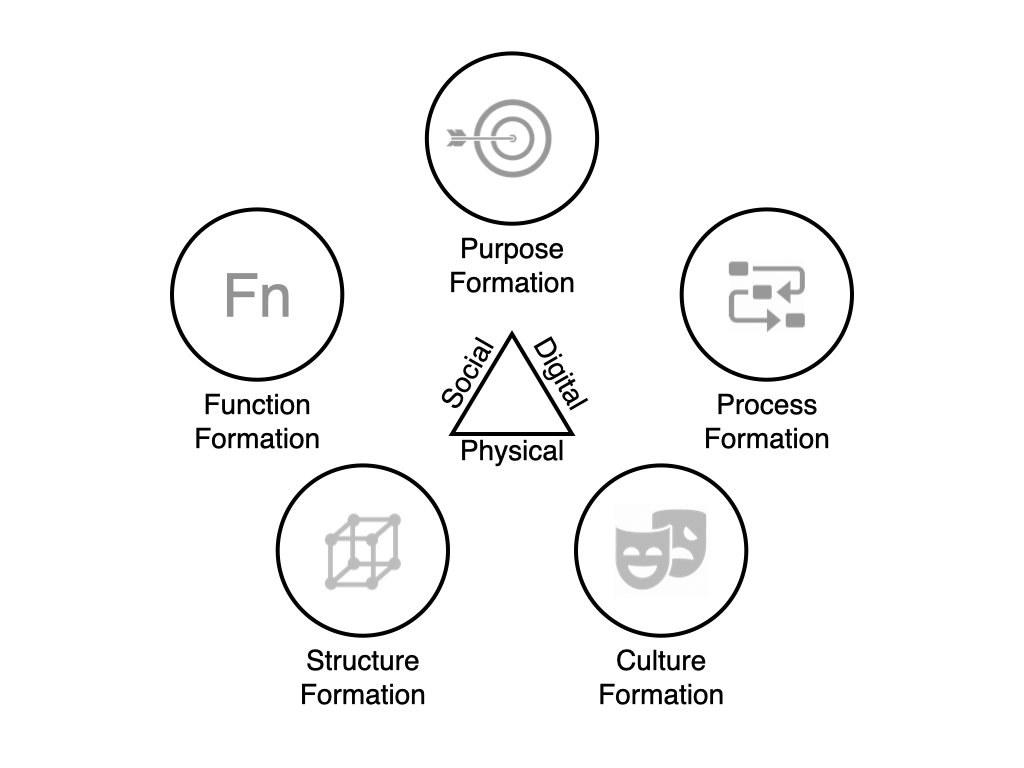
Purpose formation determines the composite identity of the organization, which is a set of roles it plays in the society.
Just like an individual whose composite identity can be defined, for instance, as Mother, Daughter, Sister, Friend, Citizen, Employee, Volunteer, and Guardian, an organization also has a composite identity, which could, for example, be Employer, Service Provider, Product Producer, Partner, Tax Payer, and Profit Generator.
Function formation determines the behaviour of the organization, it’s the ways it exchanges value with customers and clients.
Process formation determines the secret inner workings of the organization’s operations. It is not visible to an external observer.
Structure formation determines a network of actors who enter the stage to play certain roles in the process.
Culture formation determines the climate of the organization, it’s a psychological atmosphere that can either energize or demotivate the actors in the organization.
Each formation of purpose, function, process, structure, and culture causes a series of changes in social, digital, and physical structures of the organization.
Transformation is not easy. And neither are reformation and deformation.
The implication is this: when we’re getting down to work on transformations, and especially on digital transformations, as many organizations are trying to do nowadays, the first question we should ask is, perhaps, not how we do it.
Perhaps we should ask whether it really is a transformation in the first place.
Perhaps reformation, transformation, and deformation require very different strategies and tactics.
And perhaps, not everything we do can and should be put under the all-catching umbrella of transformation.
We have to do better than that to face the challenges of our organizations, to survive the present, and to prepare for the future.
What are you transforming in your organization?
{END}
 Noah Fang
2 comments